Yoga — An Ancient Indian Spiritual Tradition
Yoga developed on the Indian subcontinent and became deeply woven into Hinduism, also known as Sanatan Dharma, as a family of paths for disciplined living, self-knowledge, devotion, meditation and liberation.
What Does “Yoga” Mean?
The Sanskrit word Yoga (योग) comes from the verbal root yuj, associated with joining, yoking, harnessing or disciplined integration. Across Indian traditions the word acquired several related meanings: a spiritual discipline, a method of meditation, disciplined action, a path toward liberation, and the integration or mastery of body, senses and mind. Yoga is therefore much broader than the physical postures commonly associated with the word today.
Yoga Originated and Developed in India
Yoga is an Indian tradition. Its roots reach deep into the religious and philosophical history of the Indian subcontinent. Early Vedic and Upanishadic literature contains practices and ideas connected with disciplined contemplation, breath, senses, mind and liberation; the Mahabharata and Bhagavad Gita present multiple forms of Yoga; and later Patañjali systematized a major classical Yoga tradition in the Yoga Sūtras. There was not one historical moment at which a single person “invented” every form of Yoga. Rather, Yoga developed through many generations of Indian teachers, seekers and philosophical traditions.
Within Hinduism (Sanatan Dharma), Yoga became a central way of putting spiritual philosophy into practice. It could be lived through action and duty, devotion to the Divine, knowledge and discrimination, meditation, ethical self-discipline, or combinations of these paths. This is why Hindu texts can speak of several “Yogas” without treating them as mutually exclusive.
Yoga in the Indus Civilization — Harappa and Mohenjo-daro
Archaeological discoveries from Harappa and Mohenjo-daro provide striking evidence of the antiquity of Yoga in India. The famous Mohenjo-daro seal traditionally associated with Pashupati depicts a horned central figure seated in a distinctive yogic posture and surrounded by animals. Other Indus artifacts, including finds from Harappa, also portray figures seated in yoga-like postures.
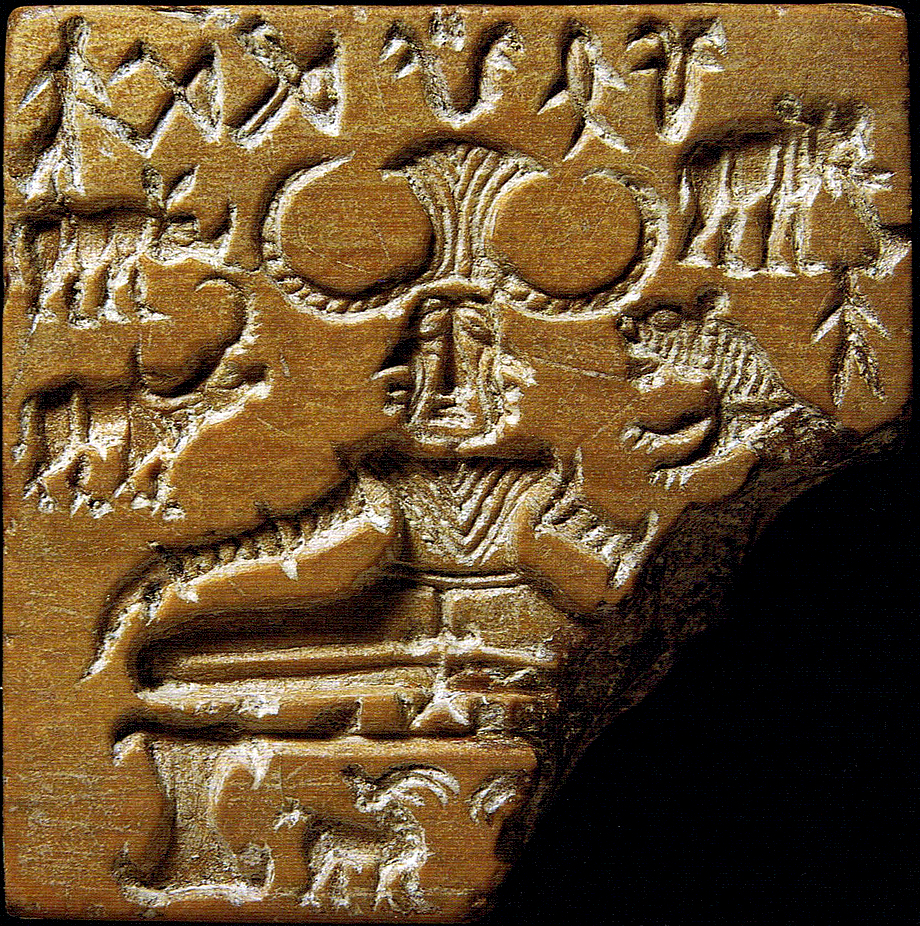
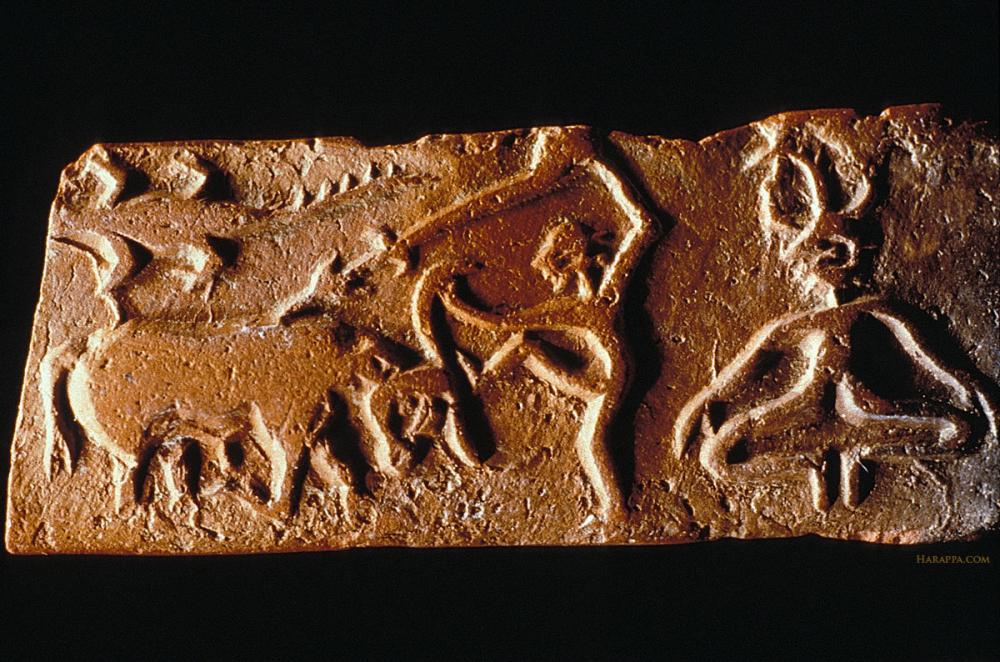
These archaeological images fit naturally within India's continuing Hindu tradition in which Shiva is revered as Adiyogi — the primordial or first Yogi. Pashupati — “Lord of Animals” — is one of the traditional names and forms of Shiva. Shiva is also traditionally associated with meditation and yogic discipline. His sacred vehicle and companion is Nandi, the bull, making the animal and yogic symbolism especially meaningful within the continuing Shaiva tradition.
Seen within this civilizational continuity, the Harappan and Mohenjo-daro imagery provides powerful archaeological context for the deep roots of Yoga and Shaiva symbolism in the Indian subcontinent. The seals belong to the Indus/Harappan civilization, thousands of years before the surviving manuscripts of later systematic Yoga texts, showing that recognizable yogic imagery was already present in ancient India.
The importance of these discoveries therefore extends beyond the history of individual Yoga texts: Yoga belongs to an ancient and continuing Indian civilizational tradition, with archaeological imagery from the Indus civilization complementing the later textual and living traditions of Yoga and Shiva as Adiyogi.
Yoga in the Bhagavad Gita
The Bhagavad Gita is one of the most influential Hindu presentations of Yoga. Its eighteen chapters repeatedly use Yoga to describe ways of living and realizing spiritual truth. Rather than limiting Yoga to posture, Krishna's teaching integrates action, knowledge, devotion, meditation, self-mastery and surrender. Chapter 2 is traditionally called Sāṅkhya Yoga, Chapter 3 Karma Yoga, and Chapter 12 Bhakti Yoga, while other chapters develop meditation, knowledge, renunciation and related forms of Yoga.
Karma Yoga — The Yoga of Action
Karma Yoga teaches disciplined action without selfish attachment to the fruits of action. A person still fulfills responsibilities—toward family, society, work and Dharma—but learns not to make personal reward, status or fear of failure the sole motive. In the Bhagavad Gita, this transforms ordinary activity into spiritual practice. Karma Yoga is therefore especially relevant to daily Hindu life: one does not necessarily need to withdraw from the world to pursue spiritual growth.
Bhakti Yoga — The Yoga of Devotion
Bhakti Yoga is the path of loving devotion and relationship with the Divine. It may be expressed through prayer, pūjā, mantra, kīrtan and bhajan, remembrance, pilgrimage, service and surrender. Hindu devotional traditions may center on Krishna, Rama, Shiva, Devi, Vishnu or another form of the Divine. The Bhagavad Gita gives Bhakti a major place and Chapter 12 is traditionally known as Bhakti Yoga. Bhakti became one of the most widely lived forms of Yoga because devotion can accompany family life, work, worship and service.
Jñāna Yoga — The Yoga of Knowledge
Jñāna Yoga emphasizes spiritual knowledge, discrimination and inquiry into the nature of the Self and ultimate reality. It is closely connected with the philosophical questions of the Upanishads: What is Ātman? What is Brahman? What is permanent and what is changing? In Vedanta traditions, knowledge is not merely accumulation of information; it aims at transformative realization concerning the deepest nature of Self and reality.
Sāṅkhya Yoga — Discriminative Knowledge
Sāṅkhya Yoga has an important place in the Bhagavad Gita, whose second chapter is traditionally titled Sāṅkhya Yoga. Sāṅkhya analyzes existence through distinctions such as the conscious principle and material nature and provides a framework for understanding the Self, action and liberation. Classical Sāṅkhya and classical Yoga became closely related philosophical systems: Sāṅkhya supplied influential metaphysical analysis, while Yoga emphasized disciplined meditative practice.
The sage Kapila is traditionally regarded as the foundational teacher of Sāṅkhya. The surviving classical system is known especially through later works such as Īśvarakṛṣṇa's Sāṅkhya Kārikā. Because the historical development of Sāṅkhya spans centuries, traditional attribution should be distinguished from claims about the authorship of surviving texts.
Dhyāna Yoga — Meditation
Dhyāna means meditation or sustained contemplation. The Bhagavad Gita's sixth chapter develops a disciplined approach to meditation, including posture, moderation, concentration and mastery of the mind. In Patañjali's system, Dhyāna is the seventh limb, following Dhāraṇā (concentration) and leading toward Samādhi (deep meditative absorption).
Patañjali and the Yoga Sūtras
Patañjali is traditionally associated with the Yoga Sūtras, the foundational aphoristic text of classical Yoga. Patañjali did not invent Yoga from nothing; he systematized pre-existing Indian yogic and philosophical traditions into an influential framework. The Yoga Sūtras focus especially on the mind, disciplined practice, meditation, freedom from afflictions and the attainment of kaivalya or liberation.
Aṣṭāṅga Yoga — The Eight Limbs
Patañjali's best-known practical framework is Aṣṭāṅga (“eight-limbed”) Yoga: Yama (ethical restraints), Niyama (personal observances), Āsana (posture), Prāṇāyāma (discipline of breath), Pratyāhāra (withdrawal or mastery of the senses), Dhāraṇā (concentration), Dhyāna (meditation), and Samādhi (meditative absorption). In this classical framework, physical posture is only one limb of a much larger ethical, mental and spiritual discipline.
Yama — Ethical Foundations
The five Yamas are traditionally Ahiṃsā (non-harming), Satya (truthfulness), Asteya (non-stealing), Brahmacarya (disciplined restraint) and Aparigraha (non-grasping/non-possessiveness). Their presence at the beginning of the eight limbs shows that classical Yoga understands ethical conduct as foundational to deeper meditation.
Yoga as Part of Hindu Life
Yoga can be practiced through many dimensions of Hindu life. Performing one's duties responsibly can become Karma Yoga; prayer, worship and loving remembrance can become Bhakti Yoga; study of the Upanishads and inquiry into Self can become Jñāna Yoga; philosophical discrimination can be connected with Sāṅkhya; and meditation can become Dhyāna Yoga. These paths frequently overlap. A person may serve others, worship the Divine, study philosophy and meditate rather than being restricted to only one approach.
Yoga Beyond Āsana
Modern global culture often uses “Yoga” primarily for systems of physical postures. Āsana is an important part of several Yoga traditions, but the historical Hindu and Indian understanding is much broader. Yoga encompasses Dharma, ethics, self-discipline, breath, concentration, meditation, knowledge, devotion, action and liberation. Understanding this larger context helps explain why Yoga has occupied such an enduring place in Indian spiritual life.
Pāṇini and Patañjali — Two Great Sanskrit Intellectual Traditions
Pāṇini and Patañjali should be distinguished, but both deserve an important place in this discussion. Pāṇini is the great Sanskrit grammarian associated with the Aṣṭādhyāyī. Patañjali is traditionally associated with the Yoga Sūtras, one of the foundational works of classical Yoga. A Patañjali is also the author of the Mahābhāṣya, the great commentary on the grammatical tradition of Pāṇini and Kātyāyana; scholars have debated whether the grammarian and the Yoga author were the same historical person.
Pāṇini — The Aṣṭādhyāyī and Systematic Sanskrit Grammar
Pāṇini composed the Aṣṭādhyāyī (“Eight Chapters”), an extraordinarily compact and systematic description of Sanskrit. Its roughly four thousand sūtras use definitions, technical markers, ordered rules, exceptions and rule interaction to describe how valid linguistic forms are generated. This sophisticated grammatical tradition helped establish and preserve the precise Sanskrit in which India's philosophical, spiritual and scientific literature could be studied and transmitted.
Pāṇini's relevance to Yoga is therefore primarily linguistic and intellectual. Sanskrit concepts such as yoga, karma, dharma, ātman, samādhi, dhyāna, prakṛti and puruṣa belong to a textual culture in which grammatical analysis became exceptionally rigorous. Pāṇini's work is also closely connected with Vyākaraṇa, grammar, one of the six Vedāṅgas.
Patañjali — The Yoga Sūtras
Patañjali is traditionally associated with the Yoga Sūtras, a concise collection of approximately 195 or 196 sūtras, depending on the textual tradition. Rather than inventing Yoga from nothing, the work systematizes and organizes older Indian contemplative, ascetic and philosophical traditions into one of the most influential formulations of classical Yoga.
The Yoga Sūtras are arranged in four pādas or chapters: Samādhi Pāda, concerning meditative absorption and the nature of Yoga; Sādhana Pāda, concerning practice, afflictions and the path of discipline; Vibhūti Pāda, concerning advanced concentration, meditation and extraordinary capacities described by the tradition; and Kaivalya Pāda, concerning liberation and the freedom of consciousness.
Patañjali's Definition and Goal of Yoga
The Yoga Sūtras famously characterize Yoga in terms of the stilling or regulation of the fluctuations of the mind (citta-vṛtti). The larger system explains how disciplined ethical conduct, practice, detachment, concentration and meditation can lead toward samādhi and ultimately kaivalya—liberation or the independence of consciousness. This makes clear why classical Yoga is much more than a system of physical exercise.
Patañjali's Aṣṭāṅga Yoga — Eight Limbs
Patañjali presents the celebrated eight limbs of Yoga: Yama (ethical restraints), Niyama (personal observances), Āsana (posture), Prāṇāyāma (discipline of breath), Pratyāhāra (withdrawal or mastery of the senses), Dhāraṇā (concentration), Dhyāna (meditation), and Samādhi (meditative absorption). The sequence shows that āsana is one component within a much larger ethical, psychological and spiritual discipline.
Patañjali and the Mahābhāṣya
There is another important Patañjali in the history of Sanskrit learning: the author of the Mahābhāṣya (“Great Commentary”), a major commentary on selected rules of Pāṇini's Aṣṭādhyāyī and Kātyāyana's observations. The Mahābhāṣya became one of the foundational works of the Sanskrit grammatical tradition. Traditional accounts have sometimes identified the grammarian Patañjali with the author of the Yoga Sūtras, while modern scholarship does not treat that identity as certain. The site therefore presents the connection without claiming that the two authors must have been the same person.
A Remarkable Intellectual Continuity
Together, these traditions illustrate different dimensions of India's intellectual heritage: Pāṇini systematized Sanskrit grammar with extraordinary precision, the grammatical Patañjali developed that tradition through the Mahābhāṣya, and the Yoga Sūtras attributed to Patañjali systematized a major tradition of disciplined meditation and liberation. Grammar helped preserve and interpret language; Yoga investigated disciplined transformation of mind and consciousness. Both relied on the compact sūtra style that enabled complex knowledge to be memorized, transmitted and explained through teacher-commentary traditions.
From India to the World
Yoga originated and developed in India and later spread far beyond the subcontinent. In the modern era it became a global practice, often emphasizing physical health, breathing and meditation. Its worldwide popularity is remarkable, but its deeper history remains rooted in Indian religious, philosophical and contemplative traditions, including Hinduism, while related yogic and meditative practices also developed in other Indian traditions.
In summary: Yoga is not only exercise. It is a diverse family of Indian spiritual disciplines whose Hindu expressions include Karma Yoga, Bhakti Yoga, Jñāna Yoga, Sāṅkhya-related paths, Dhyāna and Patañjali's Aṣṭāṅga Yoga—all directed in different ways toward disciplined living, self-understanding and liberation.