Hinduism Books Classification
Explore the traditional classification of Hindu scriptures and knowledge systems within Hinduism (Sanatan Dharma), from Shruti and the Vedas to Smriti, Itihasa, Puranas, Agamas, Darshanas, Dharma-shastras, Vedangas, and Upavedas.
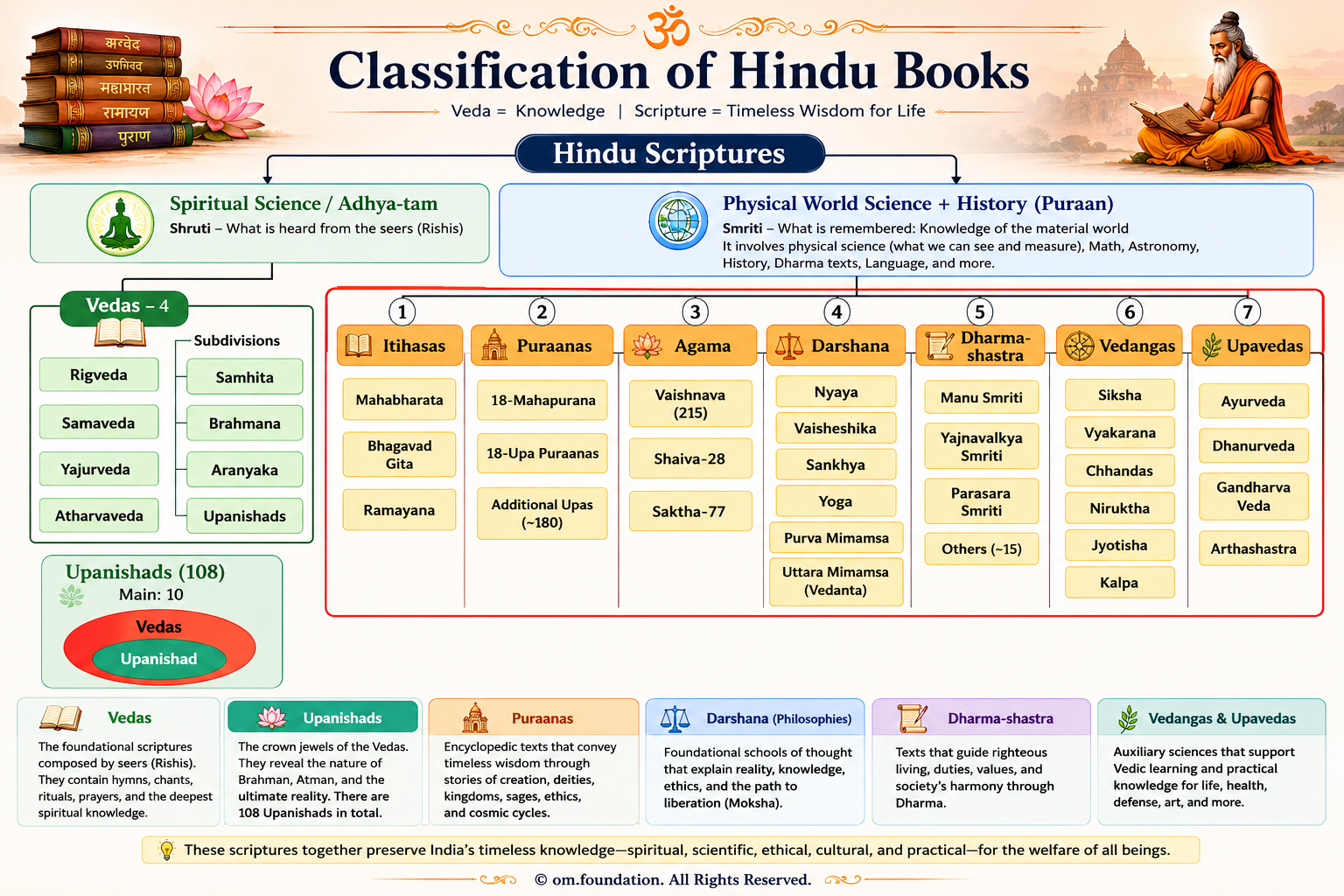
Understanding the Classification
Hindu sacred literature developed over a very long period and includes many layers of texts, traditions, schools of interpretation, ritual manuals, philosophical works, narratives, and applied bodies of knowledge. A common traditional distinction is between Shruti, meaning “that which is heard,” and Smriti, meaning “that which is remembered.” These are broad categories, and different Hindu traditions may organize or emphasize particular texts somewhat differently.
Shruti — Revealed or “Heard” Knowledge
Shruti is traditionally regarded as the most authoritative category of sacred revelation. The term literally means “that which is heard,” reflecting the traditional understanding that ancient seers, or Rishis, perceived and transmitted sacred knowledge. The Vedas form the core of Shruti literature, together with their associated layers of texts. Shruti is especially important for understanding Vedic ritual, sacred sound, philosophical inquiry, and the earliest foundations of Hindu religious thought.
The Four Vedas
The four Vedas are the Rigveda, Samaveda, Yajurveda, and Atharvaveda. The Rigveda is known especially for its hymns to deities and cosmic principles. The Samaveda adapts many Vedic verses for melodic chanting and ritual performance. The Yajurveda contains prose and verse formulas used in sacrificial rituals. The Atharvaveda includes hymns, prayers, healing formulas, domestic rites, royal rites, and reflections on life and the cosmos. Together, the four Vedas form the foundational corpus of Vedic sacred literature.
Vedic Chandas — The Meters of the Vedas
The Vedas were composed and transmitted using highly structured poetic meters known as Chandas (छन्दस्). Meter was not merely a literary ornament: together with precise pronunciation, accent and oral recitation, it helped preserve Vedic hymns with remarkable accuracy across generations. Chandas later became one of the six Vedangas—the auxiliary disciplines developed for understanding and preserving the Vedas.
Vedic meter is primarily organized by the number of syllables in each pāda (metrical quarter) and the number of pādas in a verse. Vedic poetry also pays attention to the rhythmic behavior of light (laghu) and heavy (guru) syllables, although early Vedic meters allow more variation than many later classical Sanskrit meters. Different meters give hymns distinctive pace, emphasis and sound.
Gāyatrī — 24 Syllables
Gāyatrī is among the most celebrated Vedic meters. Its standard form consists of three pādas of eight syllables each, totaling 24 syllables. The famous Gāyatrī Mantra from the Rigveda (3.62.10), addressed to Savitṛ, is traditionally identified with this meter. Its compact threefold structure gives it a distinctive rhythm and made Gāyatrī especially important in later Hindu recitation and spiritual practice.
Uṣṇih — Usually 28 Syllables
Uṣṇih is traditionally described as a meter of approximately 28 syllables. Its exact Vedic forms can vary, illustrating an important feature of early Sanskrit prosody: Vedic meters are families of rhythmic structures rather than always mechanically uniform patterns.
Anuṣṭubh — 32 Syllables
Anuṣṭubh normally has four pādas of eight syllables, totaling 32 syllables. Its Vedic form is an ancestor of the classical Sanskrit śloka that later became the dominant narrative meter of works such as the Ramayana and Mahabharata. This provides an important literary connection between Vedic poetry and later Sanskrit epic composition.
Bṛhatī — 36 Syllables
Bṛhatī is conventionally a 36-syllable meter, often represented through four pādas with a characteristic expansion beyond the basic eight-syllable pattern. Its name conveys a sense of breadth or greatness, and it belongs to the important family of meters found in Vedic hymns.
Paṅkti — 40 Syllables
Paṅkti is typically composed of five pādas of eight syllables each, totaling 40 syllables. The fivefold arrangement distinguishes it from the three-pāda Gāyatrī and four-pāda Anuṣṭubh structures and demonstrates the numerical organization underlying Vedic prosody.
Triṣṭubh — 44 Syllables
Triṣṭubh is the most frequently occurring meter in the Rigveda. Its normal structure consists of four pādas of eleven syllables each, totaling 44 syllables. Its longer lines permit greater syntactic and expressive range than Gāyatrī and Anuṣṭubh, making it especially suitable for elaborate hymnic poetry. Triṣṭubh also remained influential in later Sanskrit literature.
Jagatī — 48 Syllables
Jagatī normally consists of four pādas of twelve syllables each, totaling 48 syllables. Closely related rhythmically to Triṣṭubh but with an additional syllable in each pāda, Jagatī produces a longer and often more expansive cadence.
The Seven Principal Vedic Meters
A traditional sequence of seven important meters can therefore be summarized as Gāyatrī (24), Uṣṇih (28), Anuṣṭubh (32), Bṛhatī (36), Paṅkti (40), Triṣṭubh (44), and Jagatī (48 syllables). The progression is striking: in the conventional enumeration, each successive meter increases the total verse length by four syllables. Actual Vedic compositions contain variations, mixed forms and additional meters, so these numbers describe the standard metrical types rather than every individual verse.
Meter as a System of Oral Preservation
The metrical structure of a Vedic hymn acts as an additional framework for remembering and checking the text. A missing, added or altered syllable can disturb an expected metrical pattern. This worked alongside sophisticated Vedic recitation methods, phonetic analysis and accent traditions to support exceptionally careful oral transmission. The study of Chandas therefore belongs not only to poetry but also to the history of textual preservation, linguistics and systematic analysis in India.
India's Oral Tradition — How the Vedas Survived
For much of their history, the Vedas were preserved primarily through an extraordinarily disciplined oral tradition. Long before printed books, generations of teachers and students transmitted the texts by memorizing and reciting them with close attention not only to the words, but also to pronunciation, syllable length, Vedic accent, sound, sequence and meter. In this tradition, accurate recitation itself became a highly developed method of textual preservation.
Students traditionally learned directly from a guru, repeatedly listening to and reproducing small portions until they could recite them accurately from memory. This teacher-to-student transmission (guru-śiṣya paramparā) allowed large bodies of sacred literature to be preserved across many generations. Memorization was therefore not simply remembering the general meaning of a hymn; it involved preserving the actual sequence and sound structure of the Sanskrit text.
Multiple Recitation Methods as Cross-Checks
Vedic scholars developed several sophisticated pāṭha (recitation) methods that rearranged or repeated words in controlled patterns. In Saṃhitā-pāṭha, the text is recited in its continuous form with normal phonetic combinations. Pada-pāṭha separates the text into individual words. Krama-pāṭha recites words in overlapping pairs. More elaborate methods, including Jaṭā-pāṭha and Ghana-pāṭha, repeat words forward and backward in carefully prescribed sequences.
These methods functioned somewhat like independent cross-checks on the text. Because a passage was memorized in more than one pattern, an accidental omission, substitution or change could be easier to detect. Meter (Chandas), phonetics (Śikṣā) and grammatical analysis provided additional structures supporting accurate transmission.
Śākhās — Vedic Schools of Transmission
The Vedas were transmitted through different traditional schools known as śākhās. Individual śākhās maintained particular recensions and methods of study. Not every ancient śākhā has survived, but the existence of multiple transmission lineages is important because it shows that Vedic preservation was supported by organized communities of specialists rather than depending on a single manuscript or individual memory.
Oral Preservation Before Manuscripts and Printing
Writing and manuscripts eventually became important for preserving and studying Sanskrit literature, but within the Vedic tradition oral transmission retained exceptional authority. Manuscripts can decay, be copied incorrectly, or be lost, whereas a living community trained to reproduce a text according to strict recitation rules provides a different form of preservation. The combination of memorization, meter, accent, phonetic rules, multiple recitation patterns and teacher-student lineages is a major reason substantial Vedic textual traditions have survived into the present.
This remarkable tradition continues today in Vedic schools and recitation lineages. In 2008, UNESCO placed the Tradition of Vedic Chanting on the Representative List of the Intangible Cultural Heritage of Humanity, recognizing the sophisticated techniques used to preserve the sound and wording of the Vedas through oral transmission.
Samhitas
The Samhitas are collections of hymns, mantras, invocations, and ritual formulas that form the core textual layer of the Vedas. They preserve some of the oldest surviving Sanskrit religious compositions and are central to Vedic liturgy, sacred recitation, and ritual practice.
Brahmanas
The Brahmanas are prose texts associated with the Vedas that explain the meaning, structure, and performance of Vedic rituals. They explore symbolic relationships between ritual actions, sacred speech, cosmic order, and the duties of ritual specialists.
Aranyakas
The Aranyakas, often called “forest texts,” form a transitional layer between the ritual focus of the Brahmanas and the philosophical inquiry of the Upanishads. They frequently reinterpret outward ritual in symbolic, contemplative, and meditative terms.
Upanishads
The Upanishads contain some of the most influential philosophical teachings in Hinduism and are also described in Hindu philosophical and spiritual contexts as teachings of Transcendental Knowledge—knowledge concerned with ultimate reality and that which goes beyond ordinary sensory or material experience. They examine Atman (the deepest Self), Brahman (ultimate reality), consciousness, knowledge, death, rebirth, liberation, and the relationship between the individual and the cosmos. Tradition speaks of 108 Upanishads, although a smaller group of principal Upanishads has received the greatest philosophical attention.
Smriti — Remembered Tradition
Smriti literally means “that which is remembered.” This broad category includes texts transmitted within human tradition while drawing on older sacred principles. Smriti literature contains narrative, law, ethics, philosophy, devotional teaching, ritual guidance, cosmology, mythology, social thought, and many forms of practical knowledge.
1. Itihasas — The Great Epics
The Itihasas are the great epic narratives, especially the Ramayana and the Mahabharata. They weave together sacred narrative, ethics, politics, family duty, devotion, and Dharma. The Bhagavad Gita, contained within the Mahabharata, presents Krishna’s dialogue with Arjuna on action, duty, knowledge, devotion, spiritual discipline, and liberation.
2. Puranas
The Puranas are a vast body of literature dealing with cosmology, cycles of creation and dissolution, genealogies, sacred geography, deities, sages, pilgrimage, festivals, Dharma, and devotional teaching. Tradition commonly refers to eighteen Mahapuranas along with numerous Upa-Puranas. Different Puranas may emphasize Vishnu, Shiva, Devi, or other forms of the Divine.
3. Agamas
The Agamas are important scriptural traditions concerned especially with temple worship, ritual procedure, mantra, meditation, sacred images, temple construction, consecration, and spiritual discipline. Major Agamic traditions are associated with Vaishnavism, Shaivism, and Shaktism, and they have strongly influenced Hindu temple practice.
4. Darshanas — Philosophical Systems
Darshana means a “view,” “vision,” or philosophical perspective. Classical Hindu philosophy is commonly organized into six major systems: Nyaya, Vaisheshika, Samkhya, Yoga, Purva Mimamsa, and Uttara Mimamsa or Vedanta. Nyaya emphasizes logic and valid knowledge; Vaisheshika analyzes categories of reality; Samkhya distinguishes consciousness from primordial nature; Yoga develops disciplined methods of meditation and liberation; Purva Mimamsa focuses on Vedic interpretation, ritual, and Dharma; and Vedanta explores teachings rooted especially in the Upanishads, Bhagavad Gita, and Brahma Sutras.
5. Dharma-shastras
The Dharma-shastras discuss Dharma as it relates to ethical conduct, duties, law, family and social responsibilities, stages of life, ritual obligations, inheritance, governance, and customary practice. Works traditionally associated with this category include texts such as the Manu Smriti, Yajnavalkya Smriti, and Parashara Smriti. These texts arose in particular historical settings and have been interpreted in different ways across Hindu communities and periods.
6. Vedangas
The Vedangas are six auxiliary disciplines developed to support the preservation, interpretation, and use of the Vedas: Shiksha (phonetics), Vyakarana (grammar), Chandas (meter), Nirukta (etymology), Jyotisha (traditional calendrical and astronomical calculation), and Kalpa (ritual procedures). Together they show the care given to preserving Vedic recitation and ritual knowledge accurately.
7. Upavedas
The Upavedas are traditional bodies of applied knowledge connected with practical aspects of life. Lists vary by source, but commonly mentioned examples include Ayurveda for health and medicine, Dhanurveda for martial knowledge, Gandharva Veda for music and performing arts, and traditions of statecraft or economics. Their exact classification and relationship to individual Vedas varies across traditions.
Detailed Guide to the Texts and Subsections
The following sections expand the classifications shown in the diagram. They are intended as concise introductions rather than exhaustive descriptions; individual works can contain many books, recensions, commentaries, regional versions, and traditions of interpretation.
Rigveda
The Rigveda is the oldest of the four Vedas and is organized primarily as a collection of hymns (richas) addressed to deities and cosmic powers such as Agni, Indra, Soma, Varuna, Ushas, and others. Its hymns address ritual, creation, cosmic order, prayer, praise, philosophical speculation, and the relationship between human beings and the sacred. Several later Hindu philosophical ideas have important antecedents in Rigvedic hymns.
Samaveda
The Samaveda is especially associated with musical chanting. Much of its verse material is drawn from the Rigveda but is arranged for liturgical singing during Vedic sacrifices. Its importance lies not simply in the words but in their melodic performance, making it a foundational source for the Vedic tradition of sacred music and chant.
Yajurveda
The Yajurveda contains formulas and instructions used by priests in performing Vedic sacrifices. It exists principally in the Shukla (White) and Krishna (Black) Yajurveda traditions. It combines mantras with ritual explanations and provides an important window into the structure and symbolism of Vedic ceremonial practice.
Atharvaveda
The Atharvaveda includes prayers, hymns, blessings, healing formulas, domestic rites, royal rituals, reflections on human concerns, and philosophical passages. Its subject matter often relates more directly to everyday life than the solemn sacrificial focus found in parts of the other Vedas.
Samhita, Brahmana, Aranyaka and Upanishad Layers
Each Vedic tradition developed interconnected textual layers. Samhitas preserve mantras and hymns; Brahmanas explain ritual performance and symbolism; Aranyakas move toward contemplative and symbolic interpretations; and Upanishads investigate profound questions concerning Self, reality, consciousness, knowledge, and liberation. For this reason, Upanishadic teaching is also commonly described in Hindu spiritual discourse as Transcendental Knowledge: inquiry into the reality that transcends ordinary material and sensory experience. These categories overlap historically and are not always separated in exactly the same way in every Vedic school.
Itihasa in Detail
Ramayana
The Ramayana, traditionally attributed to Maharishi Valmiki, tells the story of Rama, Sita, Lakshmana, Hanuman, Ravana, and many other figures. At its center are questions of Dharma: how a person should act when duties to family, kingdom, truth, justice, and personal desire come into conflict. Rama is revered in many Hindu traditions as an avatara of Vishnu and as an exemplar of righteous conduct. Sita represents courage, dignity, devotion, and endurance, while Hanuman is celebrated for extraordinary devotion, strength, humility, and service. The Ramayana exists in numerous Sanskrit, regional, devotional, and Southeast Asian retellings.
Length and Poetic Meter of the Ramayana
The traditional received Vālmīki Rāmāyaṇa is commonly described as containing about 24,000 ślokas, organized into seven kāṇḍas and roughly 500 sargas. It is one of the world's longest ancient epic poems. It is sometimes described in popular lists as the second-longest ancient Sanskrit epic after the Mahābhārata; however, because “second-longest poem in the world” depends on what works, recensions, languages and definitions are counted, this website uses the more precise formulation rather than presenting a universal world ranking.
The Rāmāyaṇa is composed predominantly in the classical śloka form of the Anuṣṭubh meter. A typical epic śloka contains 32 syllables arranged in four pādas (quarters) of eight syllables each, normally presented as two half-verses. The form is highly disciplined: Sanskrit prosody distinguishes long (guru) and short (laghu) syllables and imposes characteristic patterns and cadences within the pādas. Its combination of structure, rhythm and flexibility made Anuṣṭubh exceptionally well suited to extended narrative poetry.
Mahabharata
The Mahabharata, traditionally associated with Maharishi Vyasa, is a vast epic centered on the conflict between the Pandavas and Kauravas. Its narrative examines Dharma under extraordinarily difficult circumstances, showing that moral duty can become complex when obligations compete. The epic includes teachings on politics, ethics, kingship, family, renunciation, devotion, pilgrimage, philosophy, and liberation. It contains many important works and discourses, most famously the Bhagavad Gita.
The World's Longest Ancient Epic
The Mahābhārata is generally recognized as the longest surviving epic poem from antiquity and is commonly described as the world's longest ancient epic. The traditional Sanskrit text is said to contain approximately 100,000 ślokas—more than 200,000 individual verse lines—along with prose passages. Exact totals vary considerably among manuscript traditions and editions; for example, the scholarly Critical Edition is substantially shorter than the traditional 100,000-verse figure. Its enormous scale makes the Mahābhārata not merely a war narrative but an immense repository of stories, philosophy, Dharma, political thought, spiritual teaching and cultural memory.
Sophisticated Sanskrit Meter
The overwhelming majority of the Mahābhārata is written in śloka/Anuṣṭubh, the great narrative meter of classical Sanskrit. The normal śloka has four eight-syllable pādas, totaling 32 syllables. Its sophistication lies not simply in counting syllables: Sanskrit prosody regulates patterns of light and heavy syllables, cadence and permitted variations. The epic also employs other meters, particularly forms related to Triṣṭubh, whose longer pādas can create a different rhythmic and emotional effect. Thus the composers could vary metrical movement for elevated speeches, hymnic passages and moments of heightened intensity.
Bhagavad Gita
The Bhagavad Gita occurs within the Mahabharata as a dialogue between Arjuna and Krishna on the battlefield of Kurukshetra. Arjuna faces a profound moral crisis, and Krishna teaches him about Dharma, the eternal Self, disciplined action, knowledge, meditation, devotion, and liberation. The Gita integrates several spiritual approaches, including Karma Yoga (disciplined and selfless action), Jnana Yoga (knowledge), and Bhakti Yoga (devotion). Different Vedanta traditions interpret its teachings through their own philosophical perspectives.
The Gita's 700 Verses and Meter
The Bhagavad Gītā traditionally contains 700 verses in 18 chapters. Most are composed in Anuṣṭubh śloka, linking the Gītā rhythmically to the larger Mahābhārata. At important moments the text also uses longer meters, including Triṣṭubh-type verse. The change in meter can intensify the sound and pace of recitation, illustrating how Sanskrit chandas is part of the literary architecture of the teaching rather than merely a decorative feature.
Puranas in Detail
The 18 Mahapuranas
The tradition commonly recognizes eighteen Mahapuranas. They contain extensive accounts of creation and dissolution, divine manifestations, genealogies, sages, kings, pilgrimage places, festivals, Dharma, cosmological time, and devotional practice. Familiar examples include the Bhagavata Purana, Vishnu Purana, Shiva Purana, Markandeya Purana, Matsya Purana, Kurma Purana, and others. Their theological emphasis varies, and classification schemes themselves differ among sources.
Bhagavata Purana
The Bhagavata Purana is especially influential in Vaishnava devotional traditions. It presents devotion to Bhagavan as a central spiritual path and contains celebrated narratives of Vishnu's avataras, particularly Krishna. Its accounts of Krishna's childhood, teachings, devotees, and divine play have profoundly influenced Hindu devotion, poetry, music, dance, painting, and philosophy.
Vishnu Purana
The Vishnu Purana presents cosmology, genealogies, cycles of time, royal dynasties, Dharma, and teachings centered on Vishnu. It is an important source for Vaishnava theology and for traditional accounts of creation, preservation, dissolution, and the avataras of Vishnu.
Shiva- and Devi-Oriented Puranic Traditions
Several Puranic works and related traditions center strongly on Shiva or the Divine Mother (Devi/Shakti). They communicate theology through narratives, sacred geography, ritual teaching, devotional practice, and descriptions of divine forms. The Devi Mahatmya, contained within the Markandeya Purana, is particularly influential in Shakta traditions.
Upapuranas
The Upapuranas form another large body of Puranic literature. Traditional lists and counts vary considerably. Like the Mahapuranas, they may discuss deities, pilgrimage, ritual, cosmology, Dharma, sacred places, and regional religious traditions. Because manuscript traditions and classifications differ, fixed numerical claims about all Puranic texts should be treated cautiously.
Agamas in Detail
Vaishnava Agamas
Vaishnava Agamic traditions, particularly Pancharatra and Vaikhanasa traditions, provide detailed guidance for Vishnu temple worship, sacred images, consecration, mantra, ritual schedules, festivals, theology, and devotional discipline. They continue to influence the ritual life of many Vishnu temples.
Shaiva Agamas
Shaiva Agamas are foundational to several Shaiva traditions and describe theology, initiation, mantra, yoga, temple construction, iconography, consecration, and worship of Shiva. They are especially important for understanding the ritual and theological foundations of many historic Shiva temples.
Shakta and Tantra Traditions
Shakta Agamic and Tantric traditions center the Divine as Shakti or Devi and contain sophisticated systems of mantra, yantra, ritual, meditation, cosmology, and spiritual practice. “Tantra” covers many different traditions, so individual texts and practices should be understood in their specific lineage and historical context.
The Six Darshanas in Detail
Nyaya
Nyaya is especially concerned with logic, reasoning, debate, and valid means of knowledge (pramana). It developed rigorous methods for distinguishing sound knowledge from error and became highly influential across Indian philosophical traditions.
Vaisheshika
Vaisheshika analyzes the categories that make up reality. It is known for systematic discussions of substance, quality, motion, universals, particularity, and inherence, as well as an ancient atomistic account of the physical world. Nyaya and Vaisheshika later became closely interconnected.
Samkhya
Samkhya explains experience through the distinction between Purusha, pure consciousness, and Prakriti, primordial nature. It analyzes the evolution of mind, senses, subtle elements, and material reality and had a major influence on Yoga and many later Hindu philosophical systems.
Yoga
Yoga Darshana, classically associated with Patanjali's Yoga Sutras, presents a disciplined path for stilling the fluctuations of the mind and attaining liberating insight. Its well-known eightfold framework includes ethical restraints, observances, posture, breath discipline, withdrawal of the senses, concentration, meditation, and samadhi.
Purva Mimamsa
Purva Mimamsa investigates Vedic language, interpretation, ritual obligation, and Dharma. It developed sophisticated principles of textual interpretation and argued extensively about how Vedic injunctions communicate duties and how ritual action produces results.
Uttara Mimamsa — Vedanta
Vedanta, also called Uttara Mimamsa, draws especially on the Upanishads, Bhagavad Gita, and Brahma Sutras. Its major schools include Advaita (non-dualism), Vishishtadvaita (qualified non-dualism), and Dvaita (dualism), along with several other traditions. These schools differ in how they understand Brahman, individual souls, the universe, devotion, knowledge, and liberation.
Dharma-shastra in Detail
Manu Smriti
The Manu Smriti is one of several historical Dharma-shastra texts discussing conduct, duties, legal procedures, social organization, stages of life, penances, inheritance, and kingship. It should be read as a historical normative text rather than as a single timeless legal code followed uniformly by all Hindus. Its provisions have been interpreted, debated, revised, ignored, and criticized across different periods.
Yajnavalkya Smriti
The Yajnavalkya Smriti is another influential Dharma-shastra work, noted for its relatively systematic treatment of conduct, legal procedure, and expiation. Later legal commentators frequently engaged with it, making it important in the history of Hindu jurisprudential literature.
Parashara Smriti and Other Dharma Texts
The Parashara Smriti and numerous other Dharma texts address duties and conduct from differing perspectives. Hindu Dharma literature is therefore plural rather than represented by one universally binding book. Custom, regional practice, interpretation, and changing historical conditions have all influenced how Dharma was understood in practice.
The Six Vedangas in Detail
Shiksha — Phonetics
Shiksha concerns correct pronunciation, articulation, accent, duration, and recitation. Because Vedic texts were transmitted orally with extraordinary precision, phonetics became essential to preserving sacred sound.
Vyakarana — Grammar
Vyakarana is the discipline of grammar and linguistic analysis. The grammatical tradition associated with Panini became one of the most sophisticated systems of language analysis in the ancient world and played a major role in preserving and interpreting Sanskrit texts.
Chandas — Meter
Chandas studies poetic and Vedic meters. Understanding meter supports accurate recitation and reveals the highly structured patterns through which many Vedic hymns were composed and preserved.
Nirukta — Etymology
Nirukta explains difficult or archaic Vedic words through etymology and interpretation. Yaska's Nirukta is an important surviving work in this tradition and provides insight into early Indian approaches to language and textual explanation.
Jyotisha — Calendrical and Astronomical Calculation
Jyotisha, in its Vedanga context, is concerned especially with calendrical and astronomical calculations needed to determine appropriate ritual times. Later Indian astronomical and astrological traditions became much broader, but Vedanga Jyotisha has a specific historical role connected to ritual timing.
Kalpa — Ritual Procedure
Kalpa systematizes ritual procedures and duties. Kalpa literature includes Shrauta Sutras dealing with large Vedic sacrifices, Grihya Sutras concerning domestic rites, Dharma Sutras addressing conduct and duties, and Shulba Sutras dealing with geometrical principles used in altar construction.
Upavedas and Applied Knowledge in Detail
Ayurveda
Ayurveda is the classical Indian tradition of health and medicine. Historical Ayurvedic literature discusses anatomy, diagnosis, diet, medicinal substances, surgery, lifestyle, prevention, and theories of bodily balance. Its historical importance is substantial; modern medical decisions, however, should rely on appropriate contemporary clinical evidence and professional medical care.
Dhanurveda
Dhanurveda refers to traditions of archery, martial knowledge, weapons, military training, and the discipline expected of warriors. References to martial science occur across Sanskrit literature, although surviving textual traditions and classifications vary.
Gandharva Veda
Gandharva Veda is associated with music, song, performance, and related arts. Indian traditions developed elaborate theories of sound, melody, rhythm, dramatic performance, and aesthetic experience, contributing to the later classical traditions of music and dance.
Arthashastra and Statecraft
Arthashastra refers broadly to knowledge concerning governance, political economy, administration, diplomacy, taxation, security, and statecraft. The famous Arthashastra associated with Kautilya is an important classical work in this field. Its placement as an Upaveda is not uniform across traditional classification systems, so it is best presented as one traditional association rather than a universally accepted categorization.
Vedas and Upanishads in Hindu Philosophy
The Vedas provide the foundational textual environment from which much of later Hindu thought developed, while the Upanishads focus deeply on questions of ultimate reality, Self, consciousness, knowledge, and liberation. Later Vedanta schools interpret these teachings differently: Advaita emphasizes ultimate non-duality, Vishishtadvaita teaches a qualified unity, and Dvaita emphasizes a real distinction between the individual soul and the Supreme Being.
A Living Library Rather Than a Single Book
Hinduism does not have one single scripture that functions in precisely the same way for every Hindu tradition. Hindu sacred literature is better understood as an extensive and interconnected library developed over millennia. Different communities may center their spiritual lives on the Vedas, Upanishads, Bhagavad Gita, Ramayana, Puranas, Agamas, devotional poetry, philosophical commentaries, regional scriptures, or the teachings of particular lineages.
Note: The diagram is an educational overview. Exact counts, groupings, terminology, and textual authority can vary among Hindu traditions and scholarly classifications.
Explore Traditional Knowledge & Great Scholars
These textual traditions also connect with Indian traditions of mathematics, astronomy, medicine, natural philosophy, metallurgy, plant and animal knowledge, architecture, and other practical disciplines.