One Om, Many Forms
How Hinduism understands One Supreme Reality while honoring many divine forms.
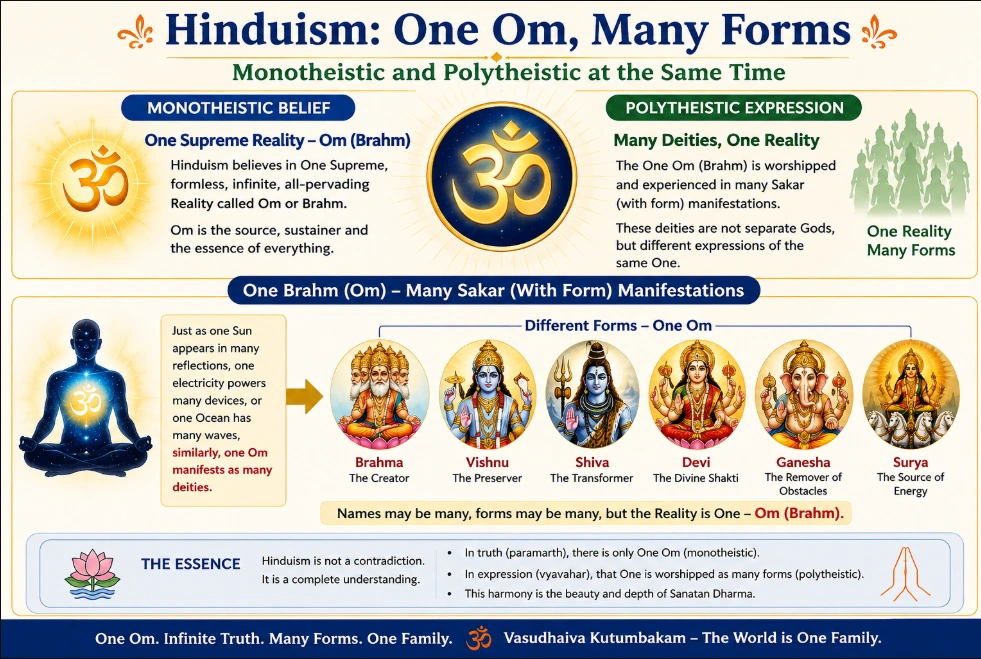
One Supreme Reality — Om or Brahman
Hinduism, also known as Sanatan Dharma, teaches that behind the many names and forms of the Divine is one ultimate Reality, commonly described as Brahman. The sacred sound and symbol Om (ॐ) represents this all-pervading Reality and the totality of existence.
One Reality, Many Divine Forms
The same Divine Reality can be worshipped and experienced through many Sakar, or “with-form,” manifestations. Brahma, Vishnu, Shiva, Devi, Ganesha, Surya and many other deities are therefore understood by many Hindu traditions not as unrelated competing Gods, but as different names, forms, powers and approaches to the same ultimate Divine Reality.
Monotheistic and Polytheistic at the Same Time
This is why Hinduism can appear both monotheistic and polytheistic. At the level of ultimate truth, there is One Supreme Reality. At the level of worship, devotion and human relationship with the Divine, that One can be approached through many sacred forms. The two perspectives are not necessarily contradictory within Hindu thought.
One Sun, Many Reflections
A common way to understand the idea is through analogy: one sun can appear in many reflections; one electricity can power many different devices; and one ocean contains innumerable waves. In the same way, the underlying Divine Reality remains One even when it is worshipped through many names and forms.
Nirakar and Sakar
Hindu traditions frequently speak about the Divine as both Nirakar—without limiting form—and Sakar—experienced through sacred form. Different philosophical and devotional traditions emphasize these ideas in different ways, but both have long-standing places within Hindu thought and worship.
The Essence
Names may be many and forms may be many, while the underlying Reality is One. This ability to recognize unity without denying diversity is one of the distinctive features of Sanatan Dharma.