Casteism Misconception
Understanding Varṇa, Jāti, social functions, colonial classification, and why discrimination by birth should not be confused with the spiritual foundation of Sanatan Dharma.
Important distinction: The English word caste is often used for several different things. Varṇa is the classical fourfold social framework described in Sanskrit literature; jāti refers to the many local, occupational, kinship and community groups that developed historically. Neither term maps perfectly onto the modern English word “caste.”
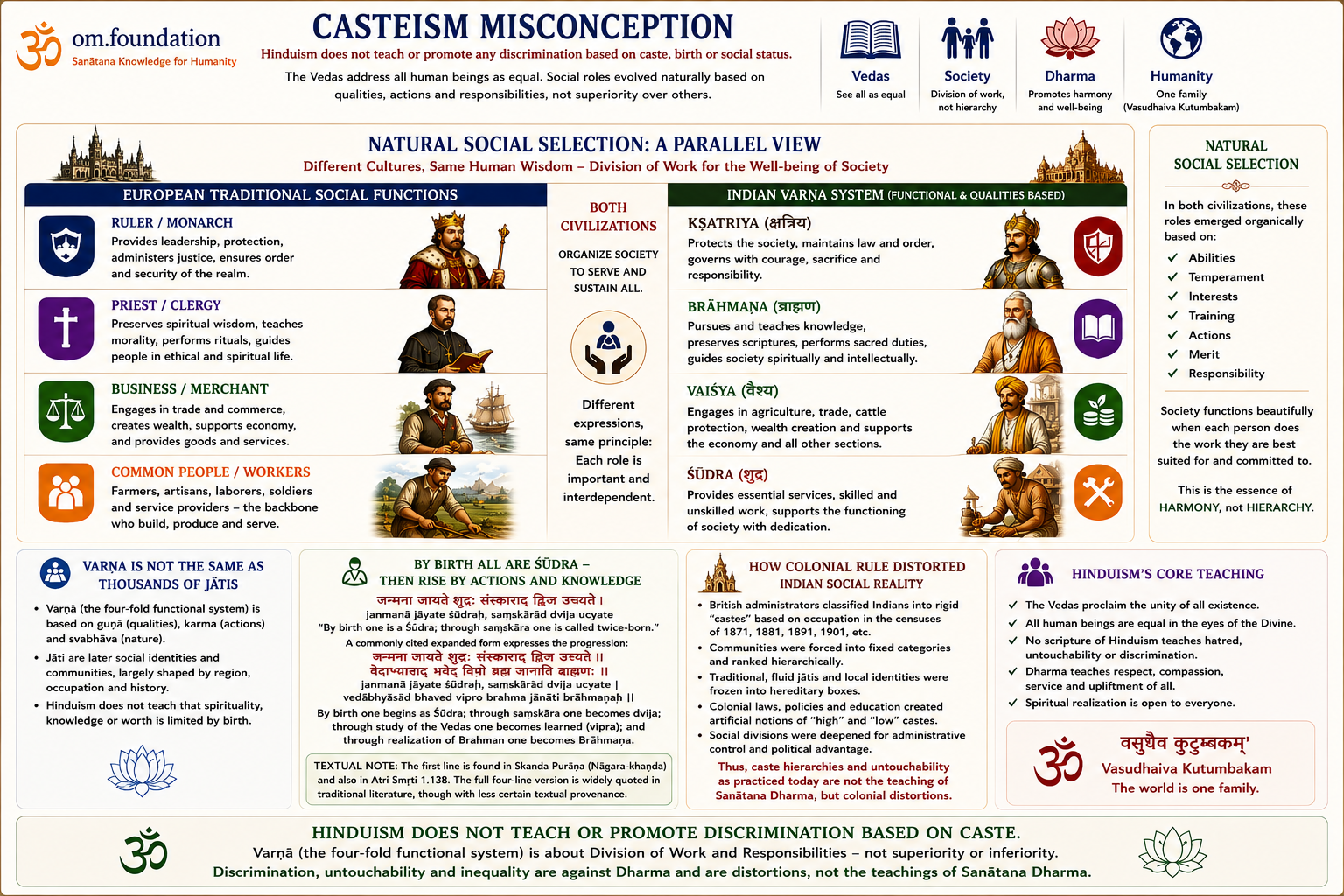
Varṇa as a Framework of Social Functions
One way for a modern reader to understand the four classical varṇas is to compare them—carefully and only as an analogy—with broad social functions found in other civilizations. Historical European societies, for example, distinguished clergy and scholars, rulers and warriors, merchants and producers, and the much larger body of workers and common people. India likewise developed categories associated with learning and ritual, protection and government, economic production, and the labor that supported society.
This comparison explains social function; it does not claim that European estates and Indian society were identical. Both regions developed their own histories of hierarchy, mobility, heredity and inequality.
What the Vedas Actually Say
It would not be accurate to say that the Vedas never mention the four social categories. Rig Veda 10.90.12, the Puruṣa Sūkta, explicitly names Brāhmaṇa, Rājanya, Vaiśya and Śūdra. The hymn uses the image of one cosmic Puruṣa: the Brāhmaṇa is associated with the mouth, the Rājanya with the arms, the Vaiśya with the thighs, and the Śūdra with the feet.
ब्राह्मणोऽस्य मुखमासीद् बाहू राजन्यः कृतः ।
ऊरू तदस्य यद्वैश्यः पद्भ्यां शूद्रो अजायत ॥brāhmaṇo'sya mukham āsīd bāhū rājanyaḥ kṛtaḥ |
ūrū tadasya yad vaiśyaḥ padbhyāṃ śūdro ajāyata ||
A functional Hindu interpretation emphasizes interdependence rather than human worth: society requires knowledge and speech, strength and protection, economic support, and the labor on which the whole body stands. This hymn does not describe the thousands of hereditary jātis later called “castes” in English, nor does this verse itself set out the elaborate caste restrictions found in later social and legal literature.
Varṇa Is Not the Same as Thousands of Jātis
The four-varṇa framework is conceptually simple. Actual Indian society developed thousands of jātis whose identities varied by region, occupation, kinship, marriage networks, political power, religious affiliation and local history. A jāti in one region might have no exact equivalent elsewhere.
Birth Alone Does Not Make a Person Learned or Spiritually Realized
A traditional Sanskrit saying expresses an important idea about human development:
जन्मना जायते शूद्रः संस्काराद् द्विज उच्यते ।
janmanā jāyate śūdraḥ saṃskārād dvija ucyate
“By birth one is a Śūdra; through saṃskāra one is called twice-born (dvija).”
In this reading, Śūdra does not mean that a newborn is spiritually inferior. It describes the starting condition of an untrained human being. Through saṃskāra—education, discipline, refinement, initiation and cultivation—a person develops knowledge, character and responsibility.
A commonly transmitted expanded form continues the progression:
जन्मना जायते शूद्रः संस्काराद् द्विज उच्यते ।
वेदाभ्यासाद् भवेद् विप्रो ब्रह्म जानाति ब्राह्मणः ॥janmanā jāyate śūdraḥ saṃskārād dvija ucyate |
vedābhyāsād bhaved vipro brahma jānāti brāhmaṇaḥ ||
The sense is: by birth one begins untrained; through refinement one becomes dvija; through Vedic study one becomes learned (vipra); and through knowledge or realization of Brahman one becomes a Brāhmaṇa. This saying is widely cited in Hindu discourse to emphasize development through education and realization rather than mere biological birth.
Textual note: The first line is found in traditional sources including the Skanda Purāṇa, Nāgara-khaṇḍa, and is also attributed in traditional citation to Atri Smṛti 1.138. The expanded four-stage version is widely transmitted, but its exact textual provenance varies across sources; om.foundation therefore presents it as a traditional saying rather than misattributing it to Manusmṛti.
Spiritual Worth Is Not Determined by Birth
At the deepest philosophical level, Hindu traditions direct attention toward Ātman, Brahman and the spiritual reality present in living beings. The Upanishadic and Vedantic traditions ask the seeker to look beyond temporary bodily identities toward the Self and ultimate reality. Bhakti movements across India likewise produced saints and teachers from many communities and repeatedly challenged social pride as an obstacle to devotion.
Historical Hindu society was diverse, and later texts do contain social rules and inequalities. Those facts should not be erased. But neither should they be turned into the claim that the spiritual essence of Hinduism requires contempt, untouchability or discrimination by birth.
How Colonial Administration Changed Caste Classification
British colonial rule did not invent every Indian social division from nothing. Varṇa, jāti, occupational communities, status differences and hereditary identities existed earlier. What colonial administration did was attempt to classify an extremely varied and locally fluid social landscape into standardized, enumerable categories.
From the nineteenth century onward, censuses, district surveys, ethnographic reports and administrative manuals increasingly required Indians to be assigned to named “castes” and “tribes.” Local identities that could be overlapping, flexible or contested were placed into official categories. Once embedded in census tables and government documents, those identities acquired greater bureaucratic permanence.
The Census and Ranking of Communities
This became particularly influential around the 1901 Census of India under H. H. Risley. Colonial ethnographers attempted to arrange communities according to social precedence and to fit India's enormous diversity of jātis into broad theories of caste and race. Communities increasingly petitioned the colonial state for particular classifications and status.
Thus, colonial rule did not create caste from nothing, but colonial census and ethnographic practices helped harden, standardize and politicize many identities that had previously been more local and context-dependent.
Occupation Does Not Determine Human Worth
No society functions without different kinds of work. Teachers, soldiers, farmers, merchants, artisans, builders, cleaners, caregivers and laborers all perform necessary functions. The body imagery of the Puruṣa Sūkta itself can be read as a reminder that every function belongs to the same whole.
Hinduism and Caste Discrimination
Hinduism (Sanatan Dharma) should not be used to justify discrimination against another human being on the basis of caste. Untouchability, humiliation, denial of opportunity or claims that a person is intrinsically inferior because of birth should be distinguished from the philosophical pursuit of Dharma, Ātman, Brahman, Yoga, Bhakti and Moksha.
A Better Way to Understand the Subject
1. Varṇa: an ancient fourfold conceptual framework of social functions.
2. Jāti: thousands of historically developed local communities and social identities.
3. Caste hierarchy and discrimination: social practices that developed differently across regions and periods and caused real injustice.
4. Colonial classification: British administrative processes that enumerated, standardized and sometimes ranked diverse communities, helping make caste identities more rigid in modern political and bureaucratic life.
om.foundation position: Sanatan Dharma is a search for Dharma, truth and spiritual realization. No person should be considered spiritually inferior, denied dignity, or discriminated against merely because of caste, jāti, occupation or birth.