Hinduism Summary
A simple framework for understanding Hinduism through four connected ideas: Om, Adhyatm, Yoga and Dharm.
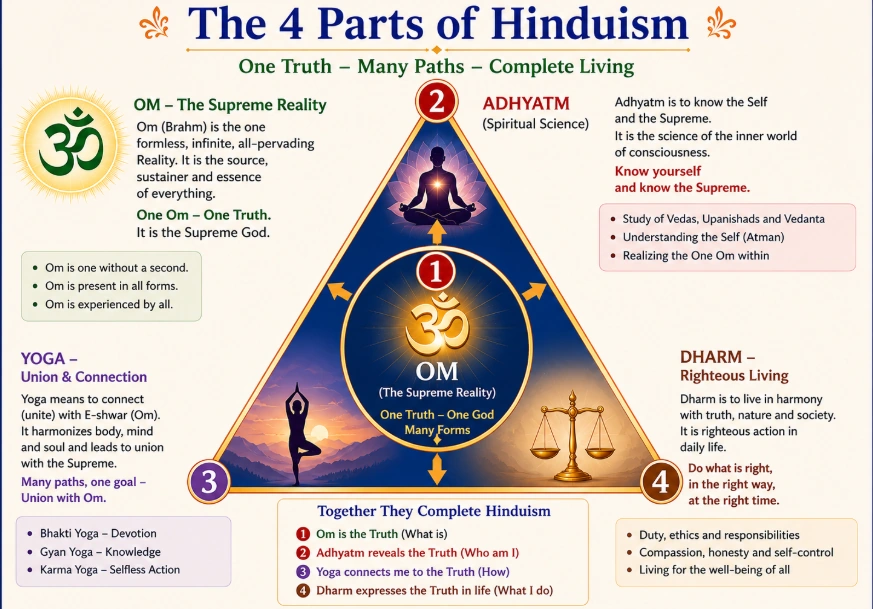
1. Om — The Supreme Reality
Om (ॐ) represents the Supreme Reality, Brahman—the formless, infinite and all-pervading truth that is the source, sustainer and essence of everything. Hindu traditions understand the many names and forms of the Divine as expressions of this one underlying Reality.
2. Adhyatm — Spiritual Knowledge
Adhyatm is the inward search to understand the Self and the Supreme. It includes inquiry into consciousness, Atman and Brahman and is deeply connected with the Vedas, Upanishads and Vedanta. In simple terms, it asks: Who am I, and what is the ultimate Reality?
3. Yoga — Union and Connection
Yoga means disciplined connection or union. Hinduism contains many yogic paths, including Bhakti Yoga through devotion, Jnana Yoga through knowledge and inquiry, and Karma Yoga through selfless action. These paths differ in method but aim toward spiritual integration and connection with the Divine.
4. Dharm — Righteous Living
Dharm is living in harmony with truth, nature, society and one's responsibilities. It includes duty, ethics, honesty, compassion, self-control and acting appropriately according to place, time and circumstance. Dharm brings spiritual understanding into everyday life.
How the Four Parts Work Together
The four ideas form a complete framework: Om is the Truth; Adhyatm reveals the Truth within; Yoga connects the individual with that Truth; and Dharm expresses the Truth through daily action. Together they connect philosophy, spiritual knowledge, practice and ethical living.
One Truth — Many Paths — Complete Living
Hinduism does not require every person to follow an identical spiritual method. One person may emphasize knowledge, another devotion, another meditation or selfless service. The underlying idea is that many valid paths can lead toward the same Supreme Reality while Dharm guides how that understanding is lived in the world.