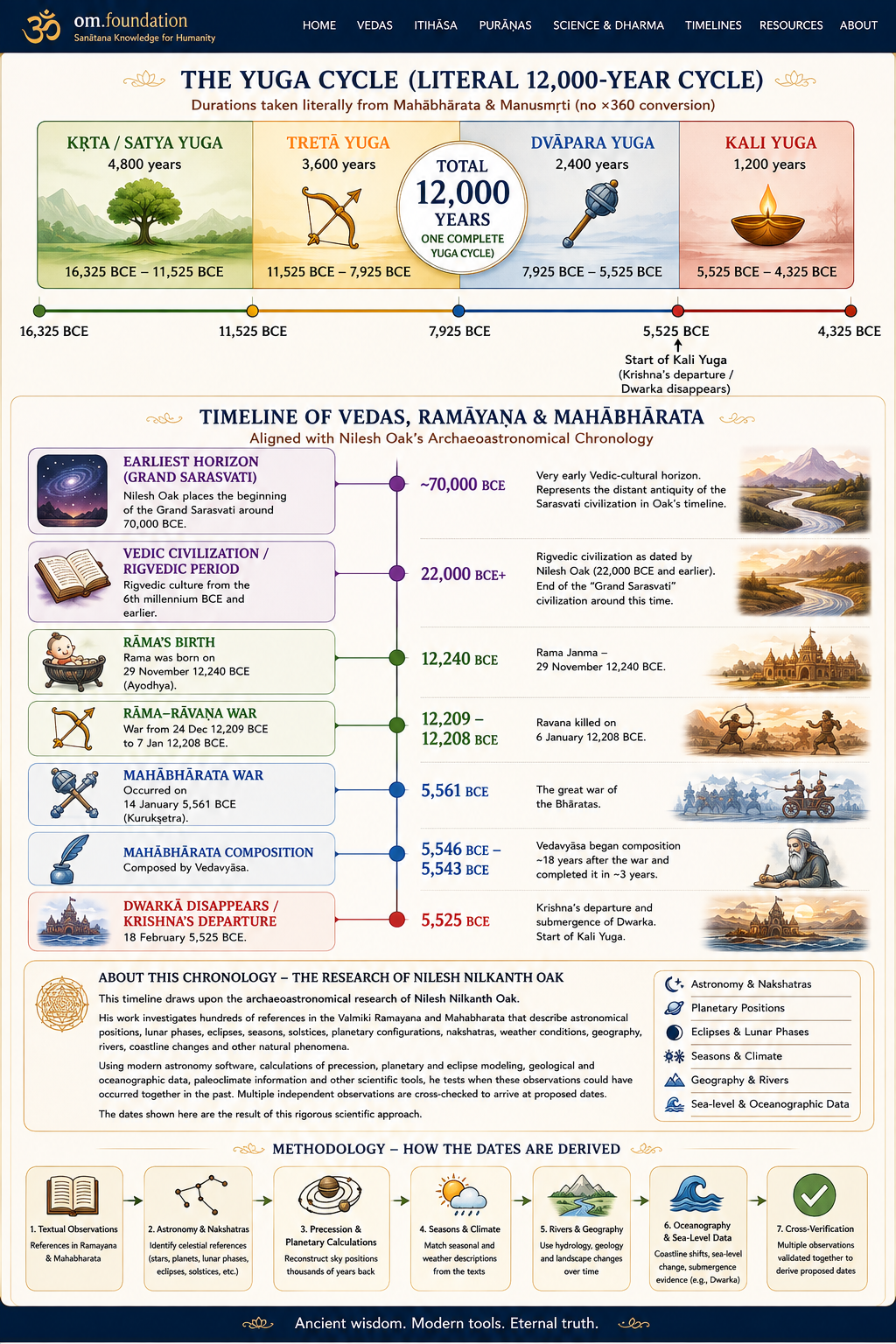
What Is Hinduism
(Sanatan Dharma)?
Hinduism, also known as Sanatan Dharma, is widely regarded as the world’s oldest continuously practiced major religious tradition. With no single founder or single point of origin, its roots extend back thousands of years to the ancient religious and philosophical traditions of the Indian subcontinent.
At its core, Hinduism explores harmony between the individual, society, nature, and the Divine through concepts such as Dharma, Karma, Samsara, and Moksha.
Hinduism — Also Known as Sanatan Dharma
Hinduism, also known as Sanatan Dharma, originated in India—Bharat—and represents one of the world's oldest continuously practiced spiritual and philosophical traditions. Rather than being based on the teachings of a single founder, Sanatan Dharma developed through a vast tradition of Rishis, philosophers, teachers, seekers, scholars and practitioners who explored fundamental questions about human life, nature, consciousness, the universe and ultimate reality.
Sanatan means eternal or timeless. Dharma is broader than religion alone. It can refer to the principles, responsibilities, ethical conduct and sustaining order that help individuals, society, nature and the larger cosmos remain in harmony. In everyday life, Dharma asks an important question: What is the right thing to do?
The Vedas — The Foundation of Vedic Knowledge
At the foundation of the Vedic tradition are the Vedas, with Veda meaning “knowledge.” The four Vedas are the Rig Veda, Yajur Veda, Sama Veda and Atharva Veda. They are regarded within Hindu traditions as Śruti—“that which is heard”—knowledge perceived or received by the ancient Rishis (seers) rather than simply invented by individual authors.
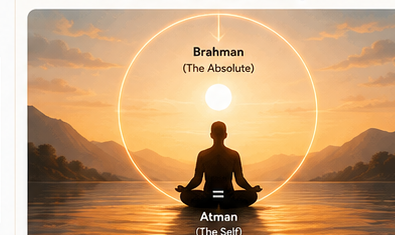
The Vedic corpus includes the Samhitas, Brahmanas, Aranyakas and Upanishads. The Upanishads form the philosophical culmination of Vedic literature and are therefore known as Vedanta. They explore profound questions concerning Atman (the Self), Brahman (Ultimate Reality), consciousness, existence, knowledge, death, rebirth and Moksha (liberation).
Om, Brahman and Non-Duality
One of the profound questions emerging from the Upanishadic tradition concerns the relationship between Atman and Brahman. Different schools of Vedanta interpret this relationship differently. Advaita Vedanta, or non-dual Vedanta, teaches that at the deepest level of reality Atman and Brahman are not separate.
Om (Aum/Oṃ) is Hinduism's most sacred sound-symbol and is given extraordinary significance in the Upanishads. The Mandukya Upanishad associates Om with the totality of existence—past, present and future, as well as that which is beyond time—and connects it with Atman and Brahman.
Indian Śāstras — A Vast Tradition of Knowledge
The intellectual tradition of India extends far beyond the Vedas. Over many centuries, Indian civilization developed extensive and systematic bodies of knowledge broadly represented by Śāstras—authoritative treatises, disciplines and traditions devoted to understanding both the physical and spiritual dimensions of existence.
Indian Śāstras and related knowledge traditions explored mathematics (Gaṇita), geometry, astronomy and calendrical science (Jyotiṣa), medicine and surgery (Ayurveda and Śalya Tantra), architecture and construction (Vāstu and Śilpa Śāstra), metallurgy and materials, Sanskrit grammar (Vyākaraṇa), logic and reasoning (Nyāya), matter and natural philosophy (Vaiśeṣika), statecraft and economics (Arthaśāstra), Yoga, philosophy, music, arts and spiritual knowledge.
This distinction is important: not every later Indian scientific or philosophical achievement should be attributed directly to the Vedas. The Vedas provided an ancient foundation, while many specialized systems of knowledge developed through Śāstras, philosophical schools, commentaries, centers of learning, scholars and centuries of intellectual inquiry.
Mathematics, Astronomy and the Natural World
Indian mathematical and astronomical traditions developed sophisticated methods for studying numbers, geometry, algebra, trigonometry, calendars, eclipses, celestial movements and planetary calculations. India's development of the decimal place-value numeral system together with zero (śūnya) became foundational to the Hindu-Arabic numeral system used throughout most of the world today. Scholars such as Aryabhata, Brahmagupta and Bhaskaracharya made major contributions to mathematics and astronomy.
Indian natural philosophy also investigated matter, motion, causation, space, time, attraction and other properties of the physical world. The Vaiśeṣika tradition associated with Maharishi Kanada, for example, developed an influential ancient theory of matter involving extremely small entities called paramāṇu. Later Indian astronomical works discuss concepts of attraction (ākarṣaṇa/ākṛṣṭi) in explaining physical phenomena. Such ideas are historically significant in their own context while they should not automatically be equated with the mathematical theory of gravity developed in modern physics.
Medicine, Surgery, Engineering and Metallurgy
Indian knowledge traditions developed extensive practical sciences. Ayurveda created systematic traditions of health, medicine, medicinal substances, diagnosis, prevention and treatment.
The Suśruta Saṃhitā preserves one of the ancient world's most remarkable surgical traditions, including surgical instruments, wound treatment, fractures and dislocations, anatomical study, surgical training, cataract procedures and detailed methods of nasal reconstruction (rhinoplasty). Suśruta is consequently widely honored in histories of medicine as the Father of Surgery or Father of Plastic Surgery.
Indian traditions also developed sophisticated knowledge of architecture, construction, metallurgy, ironworking, alloys, crafts and materials. The famous Iron Pillar of Delhi, which has survived for roughly sixteen centuries with remarkable resistance to corrosion, is an important physical example of India's historical metallurgical achievements.
Ships, Navigation and Vimānas
India had a long tradition of maritime activity, ships, navigation, ports and international trade. Ancient Sanskrit literature contains references to nau and naukā—boats and ships—while archaeological sites such as Lothal provide evidence of the maritime and commercial networks of the Harappan civilization.
Sanskrit epics and later literature also contain descriptions of vimānas or aerial vehicles, including the famous Pushpaka Vimāna of the Ramayana. These accounts are important parts of India's literary heritage; they should be distinguished from archaeological or historical evidence demonstrating technological aircraft or spacecraft.
The Outer Universe and the Inner Self
One of the fascinating characteristics of Indian civilization is that its traditions investigated both the outer world and the inner world. Mathematicians investigated numbers. Astronomers studied the heavens. Physicians studied the human body. Grammarians analyzed language. Philosophers investigated matter and knowledge. Yogis investigated the mind. The Upanishadic Rishis asked an even deeper question: Who is the one experiencing all of this?
Hindu philosophical traditions consequently investigate not only the physical universe but also mind, consciousness, Atman, Brahman, Karma, rebirth and Moksha. Hindu texts describe Atman as unborn and indestructible. This is a spiritual and metaphysical teaching about the Self rather than the modern physical law of conservation of energy.
Rishis — The Seers of Knowledge
The ancient sages associated with Vedic knowledge are known as Rishis, commonly translated as “seers.” Hindu tradition understands them as individuals who perceived or realized truths already inherent in reality. This expresses an important principle: truth does not become true because someone invents it; it is discovered because it is already part of reality.
An Extraordinary Tradition of Preservation
For centuries, the Vedas were transmitted through a highly disciplined oral tradition. Students memorized not merely the general meaning but the exact words, pronunciation, pitch accent, syllable length, sequence and poetic meter. Sophisticated recitation methods such as Samhita-patha, Pada-patha, Krama-patha, Jata-patha and Ghana-patha provided multiple ways of memorizing and cross-checking the same material. This extraordinary culture of memorization and teacher-to-student transmission helped preserve Vedic texts across generations long before modern printing.
A Continuing Search for Truth
Sanatan Dharma therefore encompasses far more than a collection of religious rituals. It represents a vast and continuing tradition of inquiry into Dharma, nature, mathematics, medicine, matter, language, mind, consciousness, the Divine and ultimate reality.
Its different traditions do not always provide identical answers. Vedanta, Samkhya, Yoga, Nyaya, Vaisheshika, Mimamsa, Bhakti traditions and numerous other schools developed different perspectives and debated one another for centuries. Yet they share a remarkable underlying pursuit: to understand reality, to understand ourselves, to live according to Dharma and ultimately to seek freedom from ignorance and suffering.