Divine-Year Yugas: Astronomy, Paleontology and Human Evolution
An interdisciplinary exploration of the Ramayana and deep time — a research hypothesis, not an established historical chronology.
1. The traditional divine-year interpretation
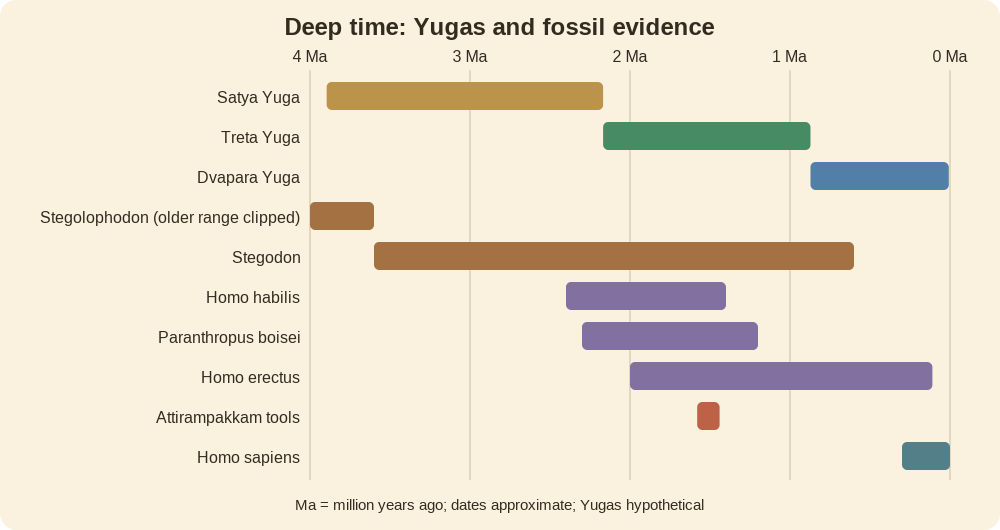
Manusmriti 1.69–71 and Mahabharata, Shanti Parva (chapter 224 in some editions), describe the four ages. Under the traditional conversion of one divine year to 360 human years, the Mahayuga spans 4,320,000 human years. For this experiment only, we anchor Kali Yuga to Nilesh Oak’s proposed Mahabharata War date of 5561 BCE, rather than the conventional epoch of 3102 BCE.
| Yuga | Divine years | Human years | Beginning | Ending |
|---|---|---|---|---|
| Satya | 4,800 | 1,728,000 | 3,893,561 BCE | 2,165,561 BCE |
| Treta | 3,600 | 1,296,000 | 2,165,561 BCE | 869,561 BCE |
| Dvapara | 2,400 | 864,000 | 869,561 BCE | 5561 BCE |
| Kali | 1,200 | 432,000 | 5561 BCE | 426,440 CE |
2. Astronomical precession and Rama’s birth
Axial precession changes the orientation of Earth’s rotational axis. A full cycle is approximately 25,772 years today; a quarter cycle is about 6,443 years and shifts the equinox by about 90 degrees, not back to the same Nakshatra. A Nakshatra spans 13°20′ in the equal-division system.
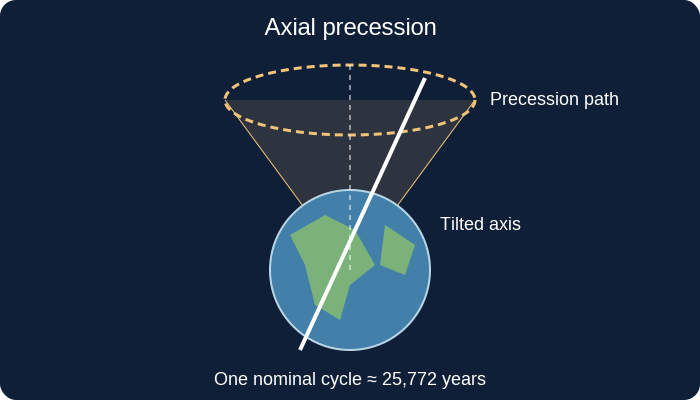
Using Oak’s proposed Rama birth date of 12,240 BCE as a mathematical reference:
T(n) = 12,240 + 25,772 × n BCE
Here n is the number of nominal full cycles backward. Cycles 34–83 fall within the calculated Treta Yuga. This is a constant-period arithmetic model, not a reconstruction of the ancient sky.
| Cycles | Nominal date (BCE) |
|---|---|
| 34 | 888,488 |
| 54 | 1,403,928 |
| 55 | 1,429,700 |
| 56 | 1,455,472 |
| 57 | 1,481,244 |
| 58 | 1,507,016 |
| 59 | 1,532,788 |
| 60 | 1,558,560 |
| 65 | 1,687,420 |
| 70 | 1,816,280 |
| 75 | 1,945,140 |
| 77 | 1,996,684 |
| 83 | 2,151,316 |
Valmiki Ramayana, Bala Kanda 18, describes Chaitra, the ninth lunar day, Punarvasu and planetary conditions. A valid test would require lunar phase, stellar positions, planetary longitudes, calendar interpretation and uncertainty in Earth’s rotation and precession. Stellar proper motion and changing orbital dynamics make million-year extrapolation particularly uncertain.
3. Four-tusked elephants
Sundara Kanda 4 describes four-tusked elephants (चतुर्दन्त, caturdanta) in Lanka; Sarga 27 also uses the motif in Trijata’s dream. Extinct proboscideans such as Gomphotherium and Stegolophodon possessed upper and lower tusks. This is a genuine anatomical parallel, but the text does not identify a fossil species.
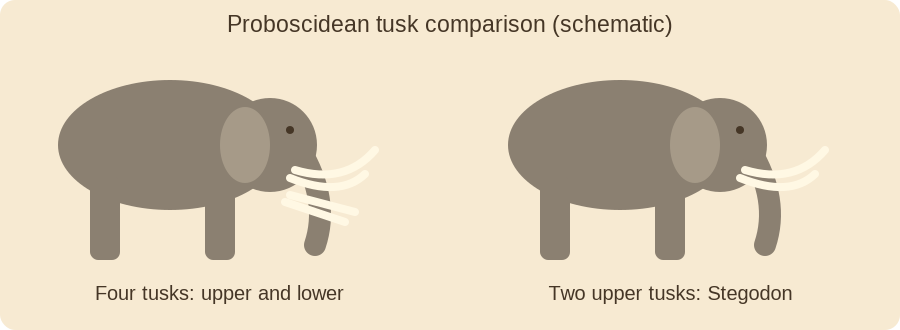
Siwalik Stegolophodon records are generally older than the proposed Treta window; Stegodon overlaps it but normally had two upper tusks. A later four-tusked South Asian population would need to be independently documented. The four-tusked Airavata tradition and poetic imagery are alternative explanations. A fossil’s age cannot by itself date a literary narrative.
4. Hanuman Ji, Vanaras and human evolution
Hanuman Ji is revered for devotion, courage, wisdom and service to Rama. The Vanaras are described as intelligent forest beings capable of speech, cooperation and extraordinary feats. Could these descriptions preserve a memory of encounters with other hominins? This is a speculative research question, not a biological identification of Hanuman Ji. Modern apes are not ancestors currently transforming into humans; humans and other apes share common ancestors, and evolution branches into distinct lineages.
| Hominin | Approximate age | Characteristics and geography |
|---|---|---|
| Australopithecus sediba | 1.98 million years | Climbing and upright-walking adaptations; South Africa |
| Homo habilis | 2.4–1.4 million years | Early Homo; Africa |
| Paranthropus boisei | 2.3–1.2 million years | Robust jaws; eastern Africa |
| Homo erectus | About 2 million–110,000 years | Human-like body proportions; Africa and Asia |
| Homo sapiens | About 300,000 years to present | Modern humans; earliest fossils in Africa |
Footprints from Kenya dated to about 1.5 million years ago have been interpreted as evidence of two hominin species sharing a landscape. This supports coexistence in Africa, not identification of Vanaras in India. No known hominin species had the long external tail commonly depicted in Hanuman Ji’s iconography.
5. Early humans in southern India
At Attirampakkam, Tamil Nadu, Acheulean stone tools have an estimated mean age of 1.51 ± 0.07 million years (Pappu et al., Science, 2011). The toolmakers’ species is not established. This age overlaps the hypothetical Treta Yuga. Cycle 58 yields 1,507,016 BCE, numerically close to the tool age, but the broad dating uncertainty and arbitrary recurrence model make this a coincidence rather than independent confirmation.
6. Other creatures and evidence
Jatayu and Sampati are extraordinary bird figures; Makara is an aquatic or composite creature; Rishyasringa is a horned sage, not an identified extinct animal. The Siberian unicorn (Elasmotherium) survived until roughly 39,000 years ago, outside this Treta window, and is not securely identified in the Ramayana.
7. What would establish a common date?
The 1.4–2 million-year interval overlaps early hominin diversity and the Indian stone-tool record, but no securely identified four-tusked South Asian species, modern human population or epic-era urban civilization has been demonstrated there. Palaces, chariots, writing and organized kingdoms are major archaeological difficulties for a literal dating to this interval. The hypothesis remains unconfirmed; spiritual meaning does not depend on a fossil identification.
References and further reading
- Manusmriti, chapter 1
- Valmiki Ramayana — Sanskrit and translation, Bala Kanda 18 and Sundara Kanda 4, 27.
- Pappu et al. (2011), Early Pleistocene Presence of Acheulian Hominins in South India.
- Smithsonian Human Origins — hominin species.
- Kosintsev et al., Evolution and extinction of the giant rhinoceros Elasmotherium sibiricum.
- NASA Earth science — background on Earth’s motion.